Posts

Reading Kierkegaard’s Spiritual Writings in Kashmir
Image
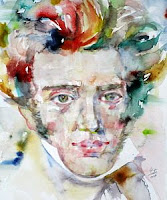
The noble souls who are dismayed by seeing how evil or untruth seemingly flourishes in the world, Kierkegaard thus consoles: “In this world, Truth walks in meekness and humiliation. It does not have a place to lay its head, and it must be thankful if one will give it a cup of water.” It has been a singular misfortune of modern Kashmiris that they have been nurtured on philosophy and culture deficient diet contributing to manifold ills besides criminal betrayal of our cultural heritage. Although our institutions and scholars had given us translations of some important literary texts, we have, largely nothing to show when it comes to philosophy for which Kashmir had been originally famous. Major modern figures in philosophy have been virtually unknown for Urdu and Kashmiri speaking people in our State as no institution/scholar had dared to translate even secondary or introductory texts.       Now, it is indeed a news (that Saifi family divulged recently) that we ...

Reconciling Faith and Sciences

Image
Why we need to read Moses Maimonides, the Great Jewish Philosopher Is it possible to remain a committed believer and completely rational scientist or philosopher at the same time? Yes, argued Moses Maimonides. This is the answer Muslims seek and if denied it leads to either fanaticism or chilling disbelief. Maimonides’ many writings including The Guide to the Perplexed are indispensable readings for those interested in larger questions of reconciling faith and science, religion and mysticism, religion and philosophy and such issues as defense of Sharia/Divine Law and Ijtihad understood as an endeavour to keep Law relevant for all times.       It has been pointed out that Maimonides symbolizes “a confluence of four cultures: Graeco-Roman, Arab, Jewish, and Western” that he is “first and foremost as an Arab thinker.”  And “if you didn't know he was Jewish, you might easily make the mistake of saying that a Muslim was writing.” A popular Jewish expression o...

The Centre of All

Image
Nothing makes sense except in the light of love. Love is central to answering all the three ultimately important questions: “(1) What can I know? (2) What should I do? (3) What may I hope?”       What is the most basic term in light of which every other term in the scripture of life or religion needs to be understood? It is love/metaphysic of love. In order to understand what religion means, one needs to master the hermeneutic of love. What constitutes the Royal Road to God and Religion’s most basic demand? Surrender of ego/self will before the non-self/God. And this transcendence of ego is an opening of love. God as Wudood can’t fail to attract/love us and we can’t resist the Irresistible Subduer ( al-Qahar ) – who is not willing to be subdued by love? Man can resist it only at the cost of hell which is choosing self exile from the Beloved. There is really only Heaven – God/Pure Consciousness as Joy/Bliss – here and now  but most men, most of the times...

Dis-ease called Life: A Dostoveskian Reading of Akhtar Mohiuddin

Image
What makes us and sustains us as humans is our need and capacity to dream, to tell stories and live in mythic space and time. One needs certain level of culture literacy to qualify as a human and, in our troubled  times,  it is poets/writers, especially of short story and novel that have been vouchsafed the task of keeping the most important question of any living culture – the question of the Being/Sacred – alive.  What makes us and sustains us as humans is our need and capacity to dream, to  tell stories and live in mythic space and time. As we find in Dostovesky: “But how could you live and have no story to tell?” And what is the key archetypal story – story of stories – that we find in all cultures? It is of Adam and Eve’s exile from and return to paradise, of frantic human effort to be, to mean, to escape the hell that life ordinarily is and be born again through love/gnosis. Dostovesky’s answer to the question “What is hell?” is  that it is “the sufferin...

Unity of Faith and Divergence of Beliefs

Image
Making sense of divergent creeds in Islamic legacy and what does it mean to be a Witness. The Prophet (SAW) attempted to wean people away from hell that is basically constituted of false views – false absolutes. People are corrupt because their views are corrupt. Ignorance is the root of evil. Commonly we see people worshipping their egos/beliefs, judging others, full of anger and complaints, envying fate of others, anxious about pseudoproblems, confusing past with timeless Tradition, fighting with themselves, their children and their doubts. That is why right view and right understanding are so important for felicity according to all religions. But how sad to note that it is hard to get access to them as religion is reduced to ideology, faith to belief, Beyond-Being and Being to personal God, God to a Super-being,  Islam (the Religion) to islam (a religion). How come there will be illumination if philosophy vetoed, mysticism suspected and debate largely proscribed? Suspicious of...

Failure of Politics

Kashmir Problem is, Primarily, a Failure of Statesmanship Badri Raina’s Kashmir : A Noble Tryst in Tatters is a first book of its kind presenting a Kashmiri Neo-Marxist account of what is wrong with Indian engagement with Kashmir. Awaited eagerly by Kashmiri readership of Indian left, it, true to the Kashmiri poetic genius, combines the poet’s view of the issue with an incisive analysis of what can only be termed as an absence of statesmanship or failure of politics. The author pleads for his essential thesis that Kashmir isn’t to be framed/can’t be understood in identitarian or communal terms or as an unfinished legacy of partition. It is simply failure of a relationship that had nothing inherently problematic about it to begin with, but turned sour due to mishandling or lack of vision and trust. India’s moral claim over Kashmir has largely been lost even though Azadi is not a solution. Vetoing against any kind of proposal of divorce between India and Kashmir, even though noting f...

Dialogue between Philosophers and Muslim Jurists

Image
Unless deep thinking is done on the issue we would continue to have much heat and little light in debates on Islamic law. Instead of saying what does Islam say we should ask what do Muslim jurists say on this or that point say Caliphate/Islamic State, rights of religious/sexual minorities/women, freedom of belief/disbelief, triple talaq, qurbani, permissibility of music, compatibility of modern banking with Islam, dress code and grooming/hair code. To claim that Islam says this or that, is, generally speaking, impossible. We can only strive to know (to make best approximations) what Islam says/God really means/intends on questions usually asked – on other questions that are more foundational we usually don’t need to ask and do largely know  what Islam says as we know what our fitrah demands or what aqli saleem requires or  what conscience allows. And jurists differ in their conclusions on almost all these questions. They don’t differ in matters of worship to significant ex...