Posts

Meeting Khizr, our own the evergreen Master
Image
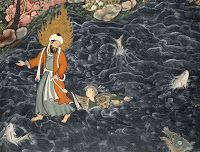
There is no final station and if there is, it is the station of no-station.  Khizr, has been a perennially sought presence across cultures. Who is he and is he around or is there Khizr within or in every other person if we are attentive enough? Is he alive or dead? Why was Moses asked to be his student? Despite such ever debated questions that have occupied/divided scholars, meeting him is generally considered a privilege though it is also said that few recognize him when this happens. He is around but we are heedless. In many subtle ways, we might have experienced his kind presence and help. So much confusion around him reigns because good works on him are not available. Partly filling the gap for Urdu reading world is Dr. G. Q. Lone’s Hazrat Khizr: Tehqeek ki Roshni Mei ; lucid book that reviews and distills centuries of scholarship on the issue though one misses engagement with modern approaches, especially myth criticism, and certain aspects of traditional science of symb...

Reading God’s Signs and Silence

Image
It is more correct to say that God finds us the moment we are ready. There is a commonly repeated complaint that prayers don’t help and God’s number is unreachable. One of the characters of Fazl Ilahi’s recently published The Signs thus gives expression to this complaint: “’God doesn’t help and reward good people. Have you seen Him helping, huh? The thing that doesn’t exist, how can it come to your rescue? Now, when you feel deprived from all sides, you reflexively create the margin for God, or the signs that you talk about. It’s psychological. Blame goes to the mystery and uncertainty of this world that forces you to run for and catch shadows.’ He smiled. ‘You actually don’t need God, you need the will to believe that things can, and surely will, improve if you keep on trying, but you know, people tend to lose hope in themselves. As they get neck deep in crisis, they withdraw into inaction, and pinning hope on something beyond that will ultimately come to their help.’”  ...

Could it be avoided?

Image
Understanding Why Good People Must Suffer. Weil explains how the idea of seeking some comfort for Imam Hussain’s camp or temptation of advising other actors in the drama or God to redirect some of its elements in more humane or moral terms that is often indulged in by some Muslims is premised on failure to understand the basic design. “Renunciation demands that we should pass through anguish equivalent to that which would be caused in reality by the loss of all loved beings and all possession, including our faculties and attainments in the order of intelligence and character, our opinions, beliefs concerning what is good, what is stable, etc. And we must not lay these things down of ourselves but lose them—like Job…” We find true renunciation in Hussain(A.S) who offers or loses all things, relationships and the last and most dear treasure, life.       In fact ultimately it is a childish question to ask how Hussain(A.S) could have saved himself or struck a be...

Some Difficult Questions

Image
Reading Simone Weil to illuminate certain nagging questions on the meaning of Karbala. There are some profound questions that Karbala raises that haven’t been satisfactorily addressed by Muslim scholars dominating the pulpit, or better known scholars of seminaries although Muslim poets and sages have to an extent engaged with them. As such certain inadequately theorized notions have been persisting making us oblivious of deeper issues. Depending on one’s background or prejudices, one finds certain elements or stories in transmitted accounts either unbelievable or lacking historical credence or incongruous. How come, for instance, Imam Hussain’s camp should beg for water? How come he was seeking safe exit or embraced death after he had no other option? What about attempts to exonerate Yazid or even mildly reprimand Hussain or downplaying meta-historical or mythic or cosmic significance of Karbala or asking what was God doing when little children who had not sinned against either Yaz...

Choosing to be Nobody: (Mis)Understanding the Passion for Fame

Understanding, with Simone Weil, the pathology of being somebody and invitation to martyrdom as an offering of “I” Arguably nine tenths of problems we face at personal, familial and social levels are due to wrong view of oneself and one’s vocation. We have not been taught or haven’t interiorized first shahadah/kalima that teaches us to give up the notion of ordinary self/ego for transpersonal Self. The passion for fame or for self aggrandizement or power or position or bossing in administrative career, awards, rewards and recognition are all aspects of the pathology of self-knowledge. Check again your deepest motivation when you choose your career. If it is for certain glamour for getting a name or becoming somebody instead of discovering nobody we truly are, one is doomed to pursue an illusion. If one is an ambitious man of career, gets readily irritated, maintains a distance from fellow people one meets in the street every day, is ever thinking about promotions, not nice to one’s...

Discussions with a remarkable Teacher

Image
Recalling some insights of Prof. Saleem Iqbal Kashmir keeps producing some memorable personalities who die unsung. One such personality, Prof. Saleem Iqbal, left us last year. His death was a loss to Kashmir’s intellectual and spiritual culture. He was larger than life, a man of immense energy, indefatigable adventurer of mindscape, reasonably good reader of select classics, friend of the poor and the marginalized and a scholar-scientist attentive to violence of exclusion in dominant epistemes of science and theology. He was among the very few truly educated professors who had not sold soul to specialization (viz. knowing only “more and more about less and less”) and knew a wider world and with authority. He knew more and more about his history, culture and religion and the ideologies that summon us to abstractions or utopias. He minced no words in giving strong judgments though occasionally one could feel him courting extremes. What was especially impressive was his generosity o...

The Quran that is

Image
It contains, self avowedly, nothing new; it is only a reminder.  Unlike great literary classics, scriptures have been assumed to be addressing particular religious communities and we find, for instance, that the Quran is mostly read by Muslims. This is more surprising when we keep in mind that for the Quran there is only one religion – Islam – and what is not named so in the form of world religions is/has been in any way a school/sect of Islam if we fully cognize significance of calling every revealed religion Islam. For the Quran the world is divided into those who know/believe/are grateful and those who don’t know/don’t believe/are not grateful. Reading the Upanishads, Tao te Ching, The Dhammapada, The Gospels – to name few – one also finds that all are addressed by them. It was never the case that man could say he doesn’t need heavenly wisdom. There is no such thing as cancelling/overriding previous wisdoms as the term naskh (cancellation) applies only to few, mostly second...