Posts

Showing posts with the label War

Why Love and Pray for Sinners and Enemies?

Image
Understanding War as Pathology of Judging Consciousness. It is rarely that one is able to realize that man’s greatest sin is being – to claim autonomy and idolize self will or attachment to sense of agency. At such rare moments one can appreciate why the first question is not “Why is there being rather than nothingness?” but “Is it just to be?” for Levinas, arguably the greatest Jewish philosopher of the postmodern world. For him the human is an “unreasonable animal” because it “cannot not admire saintliness. . . that is, the person who in his being is more attached to the being of the other than to his own.” Contrary to the laws of being, or first truth of ontology as “the struggle to be”  ethics is “against nature because it forbids the murderousness of my natural will to put my own existence first.”       The Hindu Right has been premised on othering Muslims and in turn the most influential Islamist ideologue has construed Islam as an ideology in opp...
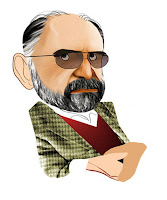
Meditations on Abdul Karim Soroush

Image
Reading Muslim Philosophers on Religious Sectarianism and Pluralism Better philosophers don’t ideally seek to convert but illuminate a problem for us to consider. We can take or not take their take on an issue but we can’t afford to be old selves after reading them. Encountering such philosophers is like encountering spiritual Masters who indelibly mark us. They open up our eyes and one begins to see another world. One learns to appreciate the other, the other point of view or other paths to truth. One learns negative capability (the capacity to be in uncertainties, mysteries, doubts, without anxiety to foreclose or jump to conclude or exclude other possibilities) that made, as noted by Keats, Shakespeare great.       Amongst contemporary Muslim philosophers, Abdul Karim Soroush is such an amiable and forceful presence that one can’t avoid falling in love with the man or at least his style. He is amongst the very few important intellectuals who has been forma...

Who Cares about our Economy?

Image
Our underperforming and ill directed economy may be seen both as a cause and symptom of our political ills. Kashmir has failed to integrate with India and it has not failed to long for Pakistan or independence. It has ridiculously bad performance in human development and other important indices. Its underperforming or ill directed economy may be seen both as a cause and symptom of its political ills. It has been weakness for rice that has been, both in symbolic and literal senses, at the centre stage of fight for Kashmir’s political future. Now Kashmir is a disaster in terms of management of natural resources (a huge fraction of them were never even considered for tapping and have been locked for reasons not difficult to fathom), unprecedented employment crisis (too many casual jobs implying casual attitude to future, most of important sectors like agriculture and livestock unorganized, mostly alienation in jobs  and we have mostly jobs that drain us further in the long run imply...

Lasting Despite Terror

Image
Reading Nayeema Mehjoor’s Lost in Terror It is undeniable that Kashmiri resistance movement has been weakened by its (mis)association with puritanical Islamist ideology, unbearable – and some inadequately documented – human costs, violence against minorities, women and imagined/projected other. It needs rare courage to report from ground zero, to direct gaze to the problematic within, to avoid mincing words and call spade a spade. To attempt to write without imposed or imagined blinkers and threats, to write back to the Empire of oppression and violence, to speak on taboo issues and take strong positions outside the comfort  zone of hypocrisy or neutrality is what a writer-journalist can aim at and to succeed to a significant extent in this endeavour is indeed an achievement.This success story deserves our attention this week.       A Kashmiri woman stranding between tradition and modernity, Kashmir and London, and caught up in transition...

Reading Alternatives

None can claim to frame Kashmir, to understand it in its entirety. Not even India and Pakistan. Much of the current debate on the need to rest the unrest in Burhan’s Kashmir misses many a point that can’t be ignored. These points include: Reasons for what is done or undone are difficult to find – or needless or besides the point – for Kashmiris because Kashmiri genius is more aesthetic than cognitive, more cultural than political and contains multitudes and therefore, in Whitmanian fashion, reserves the right to contradict. A Kashmiri looks at life in more poetic and playful than rational calculative terms. His faith is solid but human, all-too-human and not incompatible with occasional flirting with idols though repentance also follows and of course its breaking as well. Kashmir’s  movement for azadi is not a grand narrative  with a clear set of binaries and both moral and religious frames to buttress its various phases and methodologies don’t unproblematically fit o...

Reading Shamim Ahmed Shamim on Azadi - I

Image
Ideal and Reality of Kashmir’s Azadi Love is more otherworldly than this worldly phenomenon. It is a currency recognized by poets, thinkers, saints and  lovers, especially youth. Worldly wise people, politicians, traders etc. hardly count it. To live under its sacred ambience calls for nothing short of metanoai of which only few individuals are capable and not larger communities. Man lives for it and by it but more as a vision, as a noble dream, as a distant horizon of his imagination and an object of contemplation  that pulls one higher and higher. It owes its terrible beauty to the freedom it evokes. It postulates a Republic that is not necessarily this worldly state. With Eric Voegelin who has been described as modern Plato, we need to note that Plato’s Republic was written as “a dramatic dialogue about human existence in society and  history and not a policy paper for reform or an ideological tract calling for apocalyptic revolution.” Its heart is the vision o...

Freedom, as Beloved

Image
Peep deep into the heart of Kashmiris and see the image of the beloved being worshipped. No guesses.     Lovers choose to die and don’t listen to pleas for abandoning “infatuation” or juvenile romantic fantasies. Death dance they indulge is a perceived by them – and by many great tragedians – as a ritual of healing. Souls are healed and what happens to the bodies and other this-worldly businesses is not important in their view. And there are at least bouts of such “infatuation”  if not fully involved love affair in almost every Kashmiri. And occasionally this passion asserts and burns everything on its way. And that is precisely what is happening post-Burhan. Peep deep into the heart of Kashmiris and see the image of the beloved being worshipped. No guesses. All these unmistakably point to a diagnosis of affliction of love. And it doesn’t matter what the object of love is or how rational it is or what possibility of consummation of such a relationship is. For them Tols...

Thinking Kashmir?

Image
Clues from Heidegger’s What is Called Thinking? “The most thought-provoking thing about our thought-provoking age is that we are still not thinking,”______ Martin “The wasteland grows and woe to him who hides the wasteland within.” ______Friedrich Nietzsche While both Nietzsche and Heidegger said the words quoted in the beginning in somewhat different though not quite unrelated context, one recalls them readily when trying to “think” Kashmir in the context of proliferating debate on Kashmir (I don’t presume to apply Heidegger on thinking to Kashmir – this I leave to Heidegger scholars and thinkers – but only to underscore the difficulty of the task of engaging with Kashmir in the manner talk shows, conferences, political parties, gossip parties seek to do). Heidegger’s problem or objective is not to provide a map for resolving political issues but to help us attend to the deeper issues that underlie political issues. The tragedy is that one is only asked to give opinion o...