Posts

Showing posts with the label Book

Meeting Khizr, our own the evergreen Master
Image
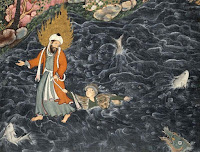
There is no final station and if there is, it is the station of no-station.  Khizr, has been a perennially sought presence across cultures. Who is he and is he around or is there Khizr within or in every other person if we are attentive enough? Is he alive or dead? Why was Moses asked to be his student? Despite such ever debated questions that have occupied/divided scholars, meeting him is generally considered a privilege though it is also said that few recognize him when this happens. He is around but we are heedless. In many subtle ways, we might have experienced his kind presence and help. So much confusion around him reigns because good works on him are not available. Partly filling the gap for Urdu reading world is Dr. G. Q. Lone’s Hazrat Khizr: Tehqeek ki Roshni Mei ; lucid book that reviews and distills centuries of scholarship on the issue though one misses engagement with modern approaches, especially myth criticism, and certain aspects of traditional science of symb...

Reading God’s Signs and Silence

Image
It is more correct to say that God finds us the moment we are ready. There is a commonly repeated complaint that prayers don’t help and God’s number is unreachable. One of the characters of Fazl Ilahi’s recently published The Signs thus gives expression to this complaint: “’God doesn’t help and reward good people. Have you seen Him helping, huh? The thing that doesn’t exist, how can it come to your rescue? Now, when you feel deprived from all sides, you reflexively create the margin for God, or the signs that you talk about. It’s psychological. Blame goes to the mystery and uncertainty of this world that forces you to run for and catch shadows.’ He smiled. ‘You actually don’t need God, you need the will to believe that things can, and surely will, improve if you keep on trying, but you know, people tend to lose hope in themselves. As they get neck deep in crisis, they withdraw into inaction, and pinning hope on something beyond that will ultimately come to their help.’”  ...

The Questions of Continuity and Fault lines

Image
Ancient, Medieval and Modern Kashmir; Insights and Problems in P. K. Nehru’s Satisar to Kashmir. Pandits are homeless in more senses than one. What is especially ignored is chosen homelessness or self exile to barren landscapes where the richness of imagination and culture one owned is disowned. Exploring one’s history, myths and literature constitute vital means to live and refuse annihilation. P.K.Nehru has done such an exploration in Satisar to Kashmir and invites Pandits to their lost selves.       The author seems to take partly historical works rather uncritically as works of history. We know Nilmat Purana is not primarily a work of history in the sense we now understand the term. And even Rajatarangini too makes us pause and requires us sift poetry from history in various places. Just an example: In Rajatarangini , Lolar, now a small part of Kupwara district, is said to be the place where 840000 buildings were constructed.     ...

Dis-ease called Life: A Dostoveskian Reading of Akhtar Mohiuddin

Image
What makes us and sustains us as humans is our need and capacity to dream, to tell stories and live in mythic space and time. One needs certain level of culture literacy to qualify as a human and, in our troubled  times,  it is poets/writers, especially of short story and novel that have been vouchsafed the task of keeping the most important question of any living culture – the question of the Being/Sacred – alive.  What makes us and sustains us as humans is our need and capacity to dream, to  tell stories and live in mythic space and time. As we find in Dostovesky: “But how could you live and have no story to tell?” And what is the key archetypal story – story of stories – that we find in all cultures? It is of Adam and Eve’s exile from and return to paradise, of frantic human effort to be, to mean, to escape the hell that life ordinarily is and be born again through love/gnosis. Dostovesky’s answer to the question “What is hell?” is  that it is “the sufferin...

Failure of Politics

Kashmir Problem is, Primarily, a Failure of Statesmanship Badri Raina’s Kashmir : A Noble Tryst in Tatters is a first book of its kind presenting a Kashmiri Neo-Marxist account of what is wrong with Indian engagement with Kashmir. Awaited eagerly by Kashmiri readership of Indian left, it, true to the Kashmiri poetic genius, combines the poet’s view of the issue with an incisive analysis of what can only be termed as an absence of statesmanship or failure of politics. The author pleads for his essential thesis that Kashmir isn’t to be framed/can’t be understood in identitarian or communal terms or as an unfinished legacy of partition. It is simply failure of a relationship that had nothing inherently problematic about it to begin with, but turned sour due to mishandling or lack of vision and trust. India’s moral claim over Kashmir has largely been lost even though Azadi is not a solution. Vetoing against any kind of proposal of divorce between India and Kashmir, even though noting f...

The Commandment of Writing

Image
Why do genuine poets or writers write? Because they are commanded to write and all they know is to obey. “Well, write poetry, for God's sake, it's the only thing that matters.” E. E. Cummings “Nothing matters but the writing. There has been nothing else worthwhile... a stain upon the silence.” Samuel Beckett Indeed, to be is to write, to proclaim to the Muse Labbayka (Here, I am). It is, more primordially, to speak and to speak in the original or true sense is to sing poetry. We know ten commandment starting with love of God and love of neighbor. But few know that both of these commandments may be best embodied in the work of poets. (“Poetry is not a discipline of knowledge but perfume or distilled essence of all disciplines of knowledge.”) Why do genuine poets or writers write? Because they are commanded to write and all they know is to obey. No questions. No turning back on the Muse. As Samuel Beckett said: ““There is nothing to express, nothing with which to express...

Revisiting Sufi Classics

Image
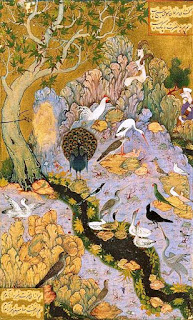
Reading Attar’s The Conference of the Birds If one is troubled by the question/crisis of faith, obsessive ritualism, difficulties in understanding the meaning of destiny and evil, guilt and hell, and if one is struggling with religious and secularist fundamentalisms and scores of questions that reason and modernity have raised regarding religion and meaning of life, consider reading Faridudin Attar. Every word of him if one could. Or at least The Conference of the Birds and its superb appropriation by Moore and Corlett in a slim volume Islamic Space that introduces the meaning of Islamic tradition for modern audience in a lucid captivating and arguably irrefutable style. For Attar, as for mystics in general, the question is not of belief/disbelief in some Beyond/God but of exploring the problem of the ego and its resistance to be dissolved by Love. The only doctrine Sufism “teaches” is detachment from/transcendence of all beliefs or positions including the one (ego/I) who seeks be...

To Be is to Pray: “Lord, Teach us to Pray”

Image
The booklet we have today with us is a compilation of prayers beginning with Rabbana (O! Lord) taught by God in the Quran. The very fact of our existence is a prayer and compels us to pray. I am: therefore I pray; sum ergo oro.   (Frithjof Schuon in Understanding Islam ) Certain people do something remarkable and deserve the gratitude of whole people. One amongst them, in Kashmir, is Abdur Rahman Kondu who: Compiled Al-Anwar at a time when little was published about Kashmir’s greatest son, Imam Anwar Shah Kashmiri – arguably recent history’s greatest Muhaddith, one of the greatest teachers in the Madrasa framework and one of the first rate Sufi metaphysicians. Has built a remarkable library that distinguishes itself from other big personal/institutional libraries in the State in many respects and is worth visiting by every lover of Islamic intellectual tradition. Lives by and off books. He can write or compile best sellers such as Rabbana (so far sold thousands of cop...