Posts

Showing posts with the label Mysticism

Appreciating the Sufi Colour of Jamaat e Islami

Syed Moududi, despite his differences with Sufism, especially its philosophical framing and the perception of divergence of its popular form from sharia , succeeded in translating the core moral and spiritual content of Sufism understood as struggle with the lower self and perfection of virtues in the pages of his work that exudes the perfume of discovery of God by a self consumed by obedience to the Divine Will. Reading Syed Moududi one finds that one is led to take God seriously and in that light see everything else. History and our odyssey get a new meaning with fellowship of God. Sufism, according to its acclaimed Masters, is not the science of states but stations and one can take his critique of world wary intoxicating bliss pursuing indulgent Sufism in positive light. Great Masters of Sufism would thank Syed Moududi for feedback on dangers of abnegating reason, eschewing self criticism and cultistic servile following of so called spiritual guides and pleading for non-attachment t...

Why Ibn Arabi Today?

Understanding the meaning of Ibn Arabi’s universalism for contemporary world and its exclusivist ideologies We are living, from centuries in the Muslim world and from around a century in the West, in the times of Ibn Arabi and Rumi as it is they who are at vital for both academic and popular intellectual, spiritual and literary landscapes today. Let us  explore something about Ibn Arabi, the most influential Sufi-metaphysician and the greatest exponent of Divine Love in the history of Islam. About him it has rightly been remarked that the subsequent Muslim thought is largely a footnote on him. And he interests almost everyone who cares to think or practise spirituality as he has ample room for all kinds of outsiders – atheists, sinners etc. His dialogues with previous prophets and saints constitute one of the most profound encounters with transcendence and proof of intimations of the higher life of Spirit. His notion of man is most comprehensive in world history.    ...

Karbala's Gift of Tears

Image
  It is time to weep for Hussain(AS). If we can’t, we need to ask God for helping us. “Tears are a gift. When we don’t know or don’t remember how to shed them, we can pray for the gift of tears. We don’t know the script. We know the Giver.” It is time to know Hussain(A.S) suffered for each one of us, for all those who are denied justice. It is time to see how suffering is a gift and thank God for it. Let us unfold all these points on the day when the noblest family on earth was massacred for the noblest ideals that ennoble and redeem life.      To be human is to suffer, to grieve and to weep. It is to suffer for the sake of that which is dearer than life, to grieve for that which ideal which humans, our predecessors or we have failed to be loyal to. It is to weep for what overcomes us and undo all resistance on our part to the decimating embrace of God/Spirit.       God made us humans and not angels. Not to weep in the name of some spiritual or my...

How Animals Humanize and Sanctify?

Image
Understanding Some Forgotten Lessons in Relationship with Animals in Traditional Cultures in general and Kashmiri Culture in particular. Why is it that children get ecstatic on seeing or contacting or playing with animals? Why is it that our dream imagery involves animals? Why is it that human history in general and sacred history in particular is also a history of our relationship to animals? What a misfortune that as we grow old our encounter with animals is often reduced to museum space only.       Animals humanize and sanctify. Our salvation is linked with them in many ways. If we fail to comprehend how and why of our fellowship with animals that we enjoyed as children or all normal children exposed to contact with animals enjoy due to our sharper perception of higher world, don’t be surprised. We have almost lost sense of a vital treasure of symbolism. Our Symbolism Illiteracy and Kashmir We fail to be humans invited for deciphering symbols. By being...

Meeting Khizr, our own the evergreen Master

Image
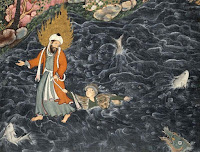
There is no final station and if there is, it is the station of no-station.  Khizr, has been a perennially sought presence across cultures. Who is he and is he around or is there Khizr within or in every other person if we are attentive enough? Is he alive or dead? Why was Moses asked to be his student? Despite such ever debated questions that have occupied/divided scholars, meeting him is generally considered a privilege though it is also said that few recognize him when this happens. He is around but we are heedless. In many subtle ways, we might have experienced his kind presence and help. So much confusion around him reigns because good works on him are not available. Partly filling the gap for Urdu reading world is Dr. G. Q. Lone’s Hazrat Khizr: Tehqeek ki Roshni Mei ; lucid book that reviews and distills centuries of scholarship on the issue though one misses engagement with modern approaches, especially myth criticism, and certain aspects of traditional science of symb...

Revisiting Sufi Classics

Image
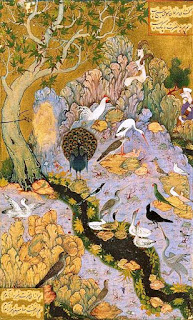
Reading Attar’s The Conference of the Birds If one is troubled by the question/crisis of faith, obsessive ritualism, difficulties in understanding the meaning of destiny and evil, guilt and hell, and if one is struggling with religious and secularist fundamentalisms and scores of questions that reason and modernity have raised regarding religion and meaning of life, consider reading Faridudin Attar. Every word of him if one could. Or at least The Conference of the Birds and its superb appropriation by Moore and Corlett in a slim volume Islamic Space that introduces the meaning of Islamic tradition for modern audience in a lucid captivating and arguably irrefutable style. For Attar, as for mystics in general, the question is not of belief/disbelief in some Beyond/God but of exploring the problem of the ego and its resistance to be dissolved by Love. The only doctrine Sufism “teaches” is detachment from/transcendence of all beliefs or positions including the one (ego/I) who seeks be...

Proxy War against Philosophy and Mysticism

Image
How Serious is Invitation to Debate Serious Matters ? Much of the Muslim world, especially the Sunni part of it, has been suffering from unwarranted fear of philosophy and now of mysticism as well. It fails to understand that philosophy, mysticism, poetry and religion have all been important parts of any living culture or tradition and unless these are integrated and given due recognition, decay occurs. One can’t give one’s soul to any one aspect and when religion claims to encompass every aspect of life, it should no longer be called religion but Ad-Deen that includes Hikmah (philosophy and mysticism, both of which have been connected with art/poetry as well). The greatest minds of all traditions including the Islamic have, mostly, been integrating in themselves all of them and they are the sages that find universal appeal in human heart. Iqbal is the greatest example in recent history reminding us of great polymaths of the past. He was called Ali-guna (Ali like) by another grea...

Grounding Religion in Mysticism

Reading Rashid Nazki’s Siriyyat Religions have had a bad press for some reasons for last few centuries. It is perceived by critics of religions that they intimidate, they require belief without or even against evidence, build their case on fear or hope while despising intelligence, are ever on war with healthy instincts, side with the oppressors, make people sleep or daydream, require following so many laws that most fail to observe and cause unnecessary guilt, censure freedom of thought in the name of blasphemy laws, tell incredible stories if taken only literally, are vulnerable to violent, misogynist, fundamentalist readings and divide people. There is a famous essay “Why I am not a Christian?” by Russell and less famous (notorious) book Why I am not a Muslim? by Ibn Warraq (both to be read along with rejoinders from Warren Rachele and Pervez Manzoor respectively). A few other equivalents against other religious positions have also been published. We find on internet proliferating...