Posts

Showing posts with the label Ummah

Syed Maududi: A Contested Legacy
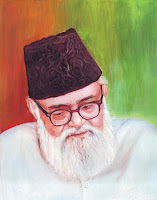
Image
Reading Eric Voegelin on Sacred Oriented Politics. We live in a world where Syed Maududi remains a presence to contend with. One is either for him or against him – there is no option of ignoring him. There remains certain ambivalence with regard to his central ideas amongst mainstream Ulema, and some intellectuals. Ambivalence may be underlined by noting sharply divided estimates of him by Hasan Askari, and his student Saleem Ahmed, two great traditionalist critics of Pakistan. Askari was quite critical of Syed Maududi and a fan of Bhutto, while for Saleem Ahmed converse was true. (Muslim religious/intellectual communities similarly remain divided in their views of revivalist theology and politics). It appears that Maududi would be better understood in relation to the thoughts of the best of his contemporaries in political philosophy and religion. One such illustrious contemporary was Eric Voegelin who shared Maududi’s commitment to the Sacred infused life and public sphere, distrust...

Rescuing Islamic Law from Legalism

Image
Reading Muhammad Asad on Respecting Common Man’s Understanding of Islam and Islamic Law. A tradition warns us that zealots – who are all around us, within us – shall die. Timely plea of Muhammad Asad, “the gift of Europe to Islam,” the famous Quran and Bukhari translator, commentator and author, “Islam should be presented without any fanaticism. Without any stress on our having the only possible way and the others are lost”. we today apply on the discourse of fiqh in the context of heated and often politicized debates on Islamic Law (e.g., on triple talaq, apostasy penalty, recent changes in Saudi Arabia)       “The task before the modem Muslim is immense”, wrote Iqbal. He went on: “He has to rethink the whole system of Islam without completely breaking with the past.’’ With the exception of Muslim feminists and the likes of Muhammad Asad, Fazlur Rahman and Ghamidi and some lesser know scholar-intellectuals Muslims seem to have largely ignored Iqbal on this...

Reconciling Islam with the Modern World

Image
Reading Benazir’s Reconciliation: Islam, Democracy and the West There are some important books that Muslim world should have taken better note of. They have something important to say though certain things might be objected to on both religious and philosophical grounds. Some selections from them deserve serious consideration. Such works include works of almost all the authors approvingly quoted in the last chapter of Benazir Bhutto’s Reconciliation: Islam, Democracy and the West . The problems that Benazir highlights are indeed noteworthy. She notes, for instance, that “now almost half the world’s Muslims are illiterate. The combined GDP of the member states of the Organization of the Islamic Conference (OIC) is about the same as that of France, a single European country. More books are translated annually from other languages into Spanish than have been translated into Arabic over the past one hundred years. The 15 million citizens of tiny Greece buy more books annually than do al...

Immunizing Against Sectarianism

Image
Historically it is the impact of poets, mystics and philosophers in Muslim cultures that has provided an antidote to sectarianism. Given the pandemic of sectarianism, how do we immunize ourselves against the deadly flu? Especially since we refuse the  imposed secularization as vaccination drive that was adopted by the West; that generates serious allergic response and throws away the baby of religion with the bathwater of sectarianism. Historically it is the impact of poets, mystics and philosophers  in Muslim cultures that has provided an antidote to sectarianism sponsored by Mullacracy and sectarian politicians. Let us see how deep rooted sectarian consciousness is in history.       For various reasons we have had divergent sectarian interpretations that have been fighting one another and thanks to changing political equations, fortunes of certain sects would change.  Earliest civil wars in Islam were fought in the name of sectarianism though...

Ummah! Revisiting Raji al-Faruqi

Image
The conception of Ummah seems to be a connecting link to the host of ideas he advocated with great force. Living in a world that appears to be decisively shaped by Enlightenment ideals, how do we theorize the conception of Islamic international community/world order or Ummah, especially in terms that modern political thought would be compelled to take a serious note of? How is it possible to teach to a world wedded to notions of democracy, nation-state, international bodies, like UN, that there is a possible ideal or an alternative to the whole trajectory that has been taken? Today, when political philosophy is exploring afresh once abandoned thinkers or notions to help us manoeuvre the problems and contradictions that have been bequeathed us by Enlightenment thinkers, we discuss a philosopher-martyr, first rate scholar and theorist of Islam and comparative religion and brilliant postcolonial intellectual, Ismail Raji Al-Faruqi who also theorized alternative political approach base...