Posts

Retrieving Iqbal for the New Generation

Image
“Why keep on harking back to Iqbal?” This is an increasingly common lament we find in certain sections today. One answer is suggested by as important a personality as Ali Shariati who has shown why Iqbal qualifies as  Ali Guna  (Ali-like) and thus deserves consideration. He has paid Iqbal one of the greatest tributes ever by an intellectual of his stature, showing him to be an unfragmented and model Muslim intellectual. Iqbal’s indeed is a mission akin to prophethood, and we need to read him to appreciate how this is the case. But it is sad to note that new generations are mostly unable to fully appreciate his Urdu verse, not to speak of his Persian works or his philosophical prose. Iqbal is to be read as a thinker, as a poet and as a reformer. He is to be read and appreciated not as an individual but as link in the great chain of Islamic theosophy. He embodies in himself the best in the Islamic intellectual tradition and is inarguably one of the most sophisticated respo...

Culture of Mistrust

Image
Once upon a time Kashmir boasted of a culture of trust despite foreign rules and slavery. Compared to situation today Kashmir was almost a heaven of trust, a generation or two back.  And trust between people and communities were grounded in common trust in God. People shared meals, milk, vegetables etc. Even dreams were not private. There were no separate rooms or bathrooms for every individual. More people could reside in a house than can reside in a Mohalla today. We had no craze for big houses, separate cars and lavish parties to advertise our vanity and show off personal empire that fundamentally results from distrust in community spirit. Today, as people no longer believe in God in practice (prayers and fasts not withstanding as people are not ready to be transformed by them afterwards) one can count on fingers in one’s community people whom one can trust. Earlier we could rarely find a person who could not be trusted. The word was important and most of tra...

How Rational Are We?

The Biblical phrase, "Know the truth, and the truth will set you free!" (John 3:24), is a powerful statement against fundamentalism of both secular and religious versions and idolatry. However, inquiry into truth has been opposed in the name of religion. Philosophy has been targeted. New thought has been suspect. Scientists have been persecuted. It means those who claim to represent religion must be questioned and not allowed to abuse the name of religion. Voltaire’s remark "The truths of religion are never so well understood as by those who have lost the power of reasoning." (Voltaire, Philosophical Dictionary, 1764) captures the essence of fanaticism. I wonder why we seldom ask ourselves what will be our answer to the question what use we made of reasoning faculty if we reject scientific attitude and philosoiphical orientation in life and seek refuge in authority of faith in domains where one is required to use reason. It has been insightfully remarked that f...

I follow the Way of Love

Image
If a Muslim is asked with which school or group or movement he identifies himself, the best answer, I think, is if one could say that he/she belongs to the ancient, universal, timeless School of Love. The vision of love as the path to Truth or the Truth itself is presented in these famous lines from TarjumanuI Ashwaq: “I follow the Way of Love, and where Love's caravan takes its path, there is my religion, my faith." There is no disbeliever in love and this implies God has succeeded in ensuring that all humans worship God to a certain degree. The best criterion for evaluating rival theological schools is how far they succeed in loving God and transcending/surrendering self will. Apply this criterion today and you can associate with or disassociate from such schools as those of Salafis, Sufis, Deobandis, Jamaatis, Reformists etc. Labels don’t much matter and what matters is how far they help in realizing the ideal of love of God. Such notions as Taqwa/Fear of God/ Love of God...

Asking the Intellectuals

I had previously expressed my doubts regarding the presence or active role of intellectuals in Kashmir. I was countered by the statement that in conflict situations intellectuals are silenced. I agreed to an extent but my questions still remain. I present a few points for further consideration. Mainstream parties plead for elections. Geelani opposes. Others declare it a non-issue. So what is going on? What should people do? Who will analyze and give an informed advice if not intellectuals? What else is the role of intellectuals if not concrete analyses, concrete answers in questions where one may find chaos or fail to choose rightly for want of understanding? I don’t propose any analysis on my part. I have attempted to learn from Socrates to ask questions. And today I ask them to intellectuals or who believe themselves to be intellectuals and were hurt when I complained about where they were. So I think the following interrelated questions and issues are relevant whi...

Who Is Not Sectarian Today?

Sectarianism costs us so much of both this world and the next that we need to fight it head on. It is best deconstructed by turning to deeper meanings revealed by metaphysical-mystical understandings of the text. It can be questioned by pointing out the dangers of all claims of finality in interpretation. We can also point out that Islam is not an interpretation of Truth on which we could fight, but an invitation to be open to Truth, and that Truth is multifaceted and can never be known in absolute terms. We can also invite all sectarian scholars to dialogue with the other. Dialogue can accomplish wonders. Habermas, a great theorist of communicative action, has defined democracy in terms of arranging dialogue between contending parties. There is a great film Twelve Angry Men concerning the jury of a homicide trail. It is a must watch for those who think dialogue is not a royal road to resolving sectarian conflicts. In it, there is initially almost a unanimous decision o...

Understanding Our Local Narratives

Image
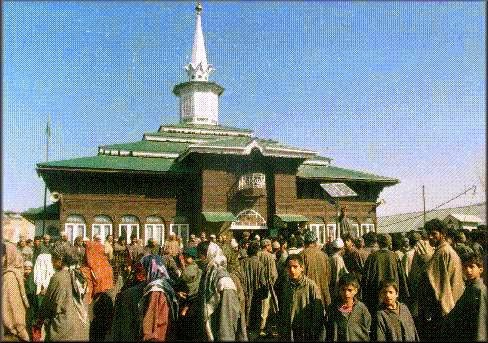
Kashmiris are famously charged with pir parasti. And this pir parasti is associated with a host of beliefs and practices that we need to take into account. The question is how to understand or engage with the local narrative. Our dismissive rejection or wholesale embracing of this narrative is what we are often supposed to choose in Kashmir. Given the ideological polarization, and the often huge costs hidden in these choices, we need to be better informed about what exactly constitutes local narratives and how far one can wish it away if one chooses to. Equally, the Salafis and others who find some problems with the local narrative need to come up with informed critique of a culture deeply affected by this narrative. Such an informed analysis of this local narrative has not been made by our historians or culture experts. And this means a lot for people in search of self-identity in times that seek to fracture such attempts. The space here won’t allow much, but here a...