Posts

How Animals Humanize and Sanctify?

Image
Understanding Some Forgotten Lessons in Relationship with Animals in Traditional Cultures in general and Kashmiri Culture in particular. Why is it that children get ecstatic on seeing or contacting or playing with animals? Why is it that our dream imagery involves animals? Why is it that human history in general and sacred history in particular is also a history of our relationship to animals? What a misfortune that as we grow old our encounter with animals is often reduced to museum space only.       Animals humanize and sanctify. Our salvation is linked with them in many ways. If we fail to comprehend how and why of our fellowship with animals that we enjoyed as children or all normal children exposed to contact with animals enjoy due to our sharper perception of higher world, don’t be surprised. We have almost lost sense of a vital treasure of symbolism. Our Symbolism Illiteracy and Kashmir We fail to be humans invited for deciphering symbols. By being...

How Islamic are Islamist Revivalist Movements?

Understanding the Gap between Traditional Islam and Modern(ist) Islamism. Much used and abused statement that Islam doesn’t separate sacred and profane, religious and political often hides more insidious, confounding of modern institution of State and traditional universe of shariah/Islamic Governance.       Given widespread confounding of Islam with Islamism/Political Islam (al-Islam al-siyasi– terms now widely used by Muslim Ulama, historians and political theorists), few points  to be noted for broad characterization of it, reviewing the debate and explaining why the latter fails to convince the best of traditional and modern scholarship: Islamism is that modern(ist) development that assumes key role for Islamic State (as distinguished from what Hallaq calls Islamic Governance) and imposing its interpretation of Islamic law on others though it may use democratic means to get power, rejects/suspects or severely limits role of philosophy, art and my...

Why Love and Pray for Sinners and Enemies?

Image
Understanding War as Pathology of Judging Consciousness. It is rarely that one is able to realize that man’s greatest sin is being – to claim autonomy and idolize self will or attachment to sense of agency. At such rare moments one can appreciate why the first question is not “Why is there being rather than nothingness?” but “Is it just to be?” for Levinas, arguably the greatest Jewish philosopher of the postmodern world. For him the human is an “unreasonable animal” because it “cannot not admire saintliness. . . that is, the person who in his being is more attached to the being of the other than to his own.” Contrary to the laws of being, or first truth of ontology as “the struggle to be”  ethics is “against nature because it forbids the murderousness of my natural will to put my own existence first.”       The Hindu Right has been premised on othering Muslims and in turn the most influential Islamist ideologue has construed Islam as an ideology in opp...

Religion as Quest for the Impossible

Image
Understanding World Religions non-ideologically with special reference to Islam and Buddhism. One of the central problems in politically inflected religious revivalist movements including Islamist ones is inadequate theorization or understanding of the object and subject of religion due to marginalization or suspicion of/veto against philosophy, mysticism, art and advances in number of sciences including mythology, comparative religion and certain natural/social sciences. In general they have a) simplistic b) homogenizing c) literalist d) exclusivist e) ideologically framed reductionist understanding that can’t withstand questioning from sciences while being vulnerable to many pathological deformations. Their standard reaction (as distinguished from response) to their critics which include mainstream traditional scholars, mystics, scientists, philosophers and artists is accusation of inauthenticity/Westoxication. They are more likely to judge, speak to, accuse, dismiss the religious/...

Let's Have a Decent Conversation

Image
The article( Connecting Religion and Politics ) published on 6th Feb, 2019 on the Readings page of GK, in response to my column( Factoring Religion in Politics ), following points may be noted Point 1: I have been accused of using vague expressions like a) “spiritual democracy”. Please ask Iqbal you own to disown his “vague” expression. Murad Hofffman’s concluding paragraph in Islam in the 21st century advocates and explains this spiritual democracy and sounds like a perennialist though he isn’t  known to be one.  b) culture being “grounded in metaphysics” – this is the most clear statement a Muslim is expected to make as part of his creed. Why forget my repeated use of term metaphysics as scientia sacra, science of First Principles that grounds ilm al-aqeedah ? Religious roots of culture grounded in Metaphysics can’t but be unalterable against “civilizational and ideological formations,” - the point is well noted by Alija Izatbegovitch, among others. Point 2: I have cata...

Finding Mercy in Hell

Image
Is there any possibility for exit for all and any hope for those who are condemned to it? Hell is obviously a bad place or state to find oneself in. But the story doesn’t end here.  There arise many questions regarding it, that cry for answers. One such important question is about God’s mercy if so many people end up in hell. And is there any possibility for exit for all and any consolation/hope/remedy for those who are condemned to it? How do we live lives if such terrible future awaits most of us/fellow humans? How come we can sleep well if it is the case that anytime anyone amongst us is going to be picked up for ultimate concentration camp? I think most of these questions hinge on understanding the nature of hell. Today we ponder on a few points to help us approach these questions.       Peter Kreeft, an influential religious figure, has this to say in his Three Philosophies of Life , on the nature of hell: “The essence of Hell is not suffering but ...

Reading Martin Buber

Image
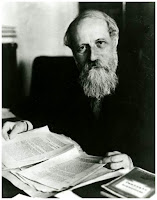
Understanding Why We Sin and Disbelieve We see people but hardly ever meet them. We talk to them but hardly ever communicate our soul or enter into a genuine dialogue with them. We owe everything to the other and hardly ever realize this and no wonder we are all lonely and are reduced to being islands unto ourselves. To speak “we” word has become a convention. Even God who addresses us in every encounter with the other we fail to notice and no wonder our worship and devotion is mostly sham. Life is such a joy, such an ecstasy, such a communion of spirit for those who know who is the other addressing them or addressed by them. It is virtually God we meet everyday in homes and streets and offices. But few feel the thrill of heavenly vision ( deedar ) in greeting and talking to fellow humans. Martin Buber, arguably the most influential Judaic philosopher-mystic, may help us here. His meditations on what does it mean to say “I” and “Thou” and “we” are an education for life. May ...